I think democrats care about the poor and middle class much more than republicans do. Lots of their policies this year are intended to provide relief to a struggling middle class families. I would like to compile tangible proof that democrats care about the struggling and down-and-out.
The first case I wanted to look at was federal minimum wages during democratic and republican administrations. During the past seven years, a republican president and congress have blocked some 14 attempts to increase the federal minimum wage. Fortunately, they lost their control of congress in 2006 and were forced into passing law increasing minimum wage from the decade long $5.15/hr to $7.25/hr over the course of a few years. The battle for federal minimum wage increases got me thinking about previous battles of its kind. So, I looked into the all-knowing Wikipedia for stats and I found this:
Since my interests were particularly partisan, I looked into how much minimum wage changed under democratic vs. republican presidents.
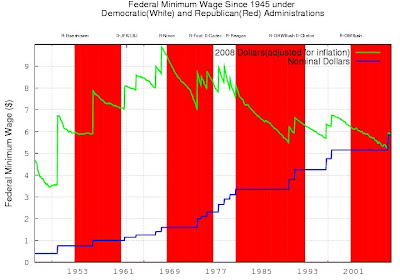 Granted there are circumstances that are out of a president's control like
The first case I wanted to look at was federal minimum wages during democratic and republican administrations. During the past seven years, a republican president and congress have blocked some 14 attempts to increase the federal minimum wage. Fortunately, they lost their control of congress in 2006 and were forced into passing law increasing minimum wage from the decade long $5.15/hr to $7.25/hr over the course of a few years. The battle for federal minimum wage increases got me thinking about previous battles of its kind. So, I looked into the all-knowing Wikipedia for stats and I found this:

Since my interests were particularly partisan, I looked into how much minimum wage changed under democratic vs. republican presidents.
 Granted there are circumstances that are out of a president's control like
- Wars, global conditions, natural disasters
- Congress might have been controlled by a party different from the president to push his agenda
Comments