In my previous post, I tried to test my theory that democrats care about poor people than republicans by looking at the change in federal minimum wage under democratic and republican presidents. It is somewhat difficult to prove or disprove my theory graphically, so I prepared a little spreadsheet and calculated real numbers. While I was at it, I decided to factor in the role of Congress in determining the federal minimum wage. The results are as follows.
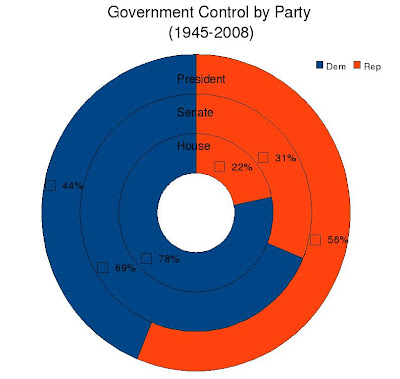
It is important to get a general feel for the extent to which the two parties have controlled the executive (president) and legislative (Senate and House) branches of the government. As the pie chart below shows, Democrats have controlled Congress for a lot longer than the Republicans, while Republican presidents have ruled a little bit longer.
SOURCE: http://uspolitics.about.com/od/usgovernment/l/bl_party_division_2.htm
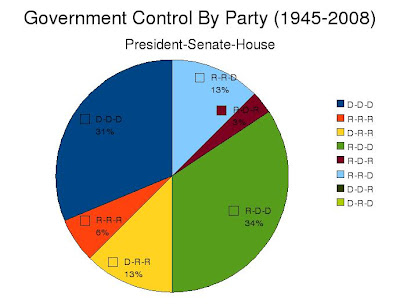
Next item to look at is government control by president, Senate and House majority. The Democrats have ruled this country either by controlling the presidency or Congress (D-D-D + D-R-R + R-D-D) 78% of the time!! It is safe to say they have played a dominant role in shaping the course of this country since WWII.
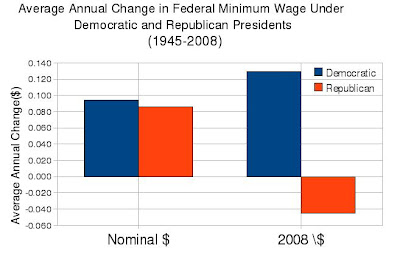
 All this analysis is intended to shade light on the correlation between the party in charge and increase in federal minimum wage. The bar chart below indicates that federal minimum wage increased by $0.094/year under Democratic Presidents and $0.086/year under Republican presidents in nominal terms. When adjusted for inflation, however, the increase spikes to $0.130/year for Democratic presidents and declines to $-0.045/year for Republican Presidents. This result is fascinating because it demonstrates that Democratic presidents have been much more willing to allow minimum wage increases AND their increases kept up with inflation while their Republican counterparts have been very stingy. Since Republican presidents have failed to increase minimum wage with inflation, they have effectively suppressed the income and purchasing power of poor people. If this is not a proof that Democrats are better for the economic well-being of poor people, I don't know what is.
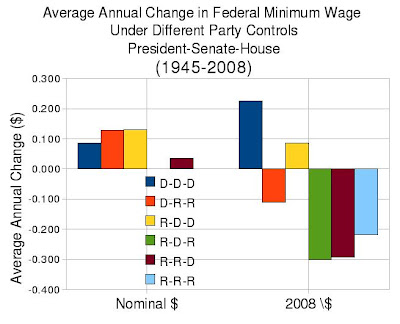
 Now, lets look at how the different party controls of the presidency as well as Congress affect federal minimum wage increases. Once again, we see Democratic presidents and Congress being willing to increase minimum wages and keep those wages up with inflation while Republicans have done neither.
 All in all, my hypothesis that Democrats have done more to help poor people by advocating increases in federal minimum wage have been proven to be pretty true. There are many factors that I have not considered, but my theory certainly has credibility.
It is important to get a general feel for the extent to which the two parties have controlled the executive (president) and legislative (Senate and House) branches of the government. As the pie chart below shows, Democrats have controlled Congress for a lot longer than the Republicans, while Republican presidents have ruled a little bit longer.
SOURCE: http://uspolitics.about.com/od/usgovernment/l/bl_party_division_2.htm

Next item to look at is government control by president, Senate and House majority. The Democrats have ruled this country either by controlling the presidency or Congress (D-D-D + D-R-R + R-D-D) 78% of the time!! It is safe to say they have played a dominant role in shaping the course of this country since WWII.
 All this analysis is intended to shade light on the correlation between the party in charge and increase in federal minimum wage. The bar chart below indicates that federal minimum wage increased by $0.094/year under Democratic Presidents and $0.086/year under Republican presidents in nominal terms. When adjusted for inflation, however, the increase spikes to $0.130/year for Democratic presidents and declines to $-0.045/year for Republican Presidents. This result is fascinating because it demonstrates that Democratic presidents have been much more willing to allow minimum wage increases AND their increases kept up with inflation while their Republican counterparts have been very stingy. Since Republican presidents have failed to increase minimum wage with inflation, they have effectively suppressed the income and purchasing power of poor people. If this is not a proof that Democrats are better for the economic well-being of poor people, I don't know what is.
 Now, lets look at how the different party controls of the presidency as well as Congress affect federal minimum wage increases. Once again, we see Democratic presidents and Congress being willing to increase minimum wages and keep those wages up with inflation while Republicans have done neither.
 All in all, my hypothesis that Democrats have done more to help poor people by advocating increases in federal minimum wage have been proven to be pretty true. There are many factors that I have not considered, but my theory certainly has credibility.
Comments